© Tusks and Tracks Africa : Design
Fishing Species Available


Make your selection and then
complete the on-line Quotation Form
Detail descriptions of fish species
species top


= Descriptions

Inland Fishing
Saltwater Ocean Fishing
Bass
Carp
Tiger Fish
Trout
Yellow Fish
Black & Striped Marlin
Bonefish
Bonito
Cape Snoek
Dorado
Saltwater Ocean Fishing
Elf
Garrick
King Mackeral
Kingfish
Kob
Queen Mackeral
Red Steenbras
Sailfish
Swordfish
Yellowfin Tuna

INLAND
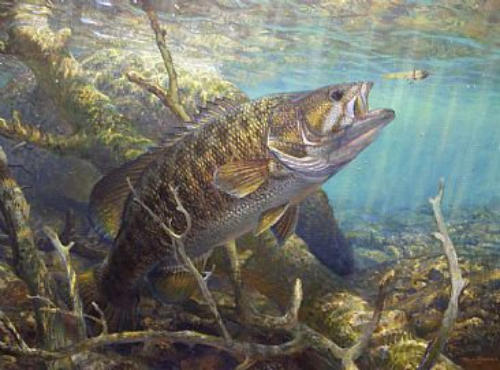
Bass
Largemouth bass were imported in the early sixties to Southern Africa from the U.S. This fish is a stealthy predator which is
known to grow up to over 10kg in weight in the U.S. Locally bass only grow to around 7-8kgs and the current SA Record is
6.29kg's although bigger specimens have been caught.
The largemouth bass inhabits many dams rivers and lakes in Southern Africa preferring structured areas where weed beds,
sunken logs, reeds, grass mats, rocky out crops etc. provide cover for them to wait in ambush for their prey which consists
of a variety of organisms such as fish, frogs, and other aquatic creatures, including terrestrial critters such as lizards, mice,
birds, snakes and insects. Besides the larger specimens most bass can be found in the shallow shorelines during warmer
months and are very active during the end of summer. It is the largest member of a group of closely-related fishes called
black bass. Others include the smallmouth, spotted, redeye, Suwannee and Guadalupe. It is distinguished from all the
others by a jaw that extends beyond the eye. All black bass, belong to the sunfish family, but differ from sunfish because
of their longer bodies.
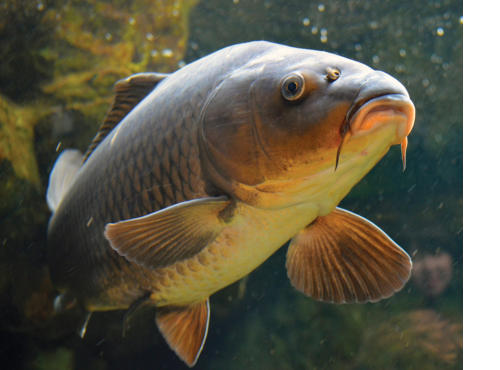
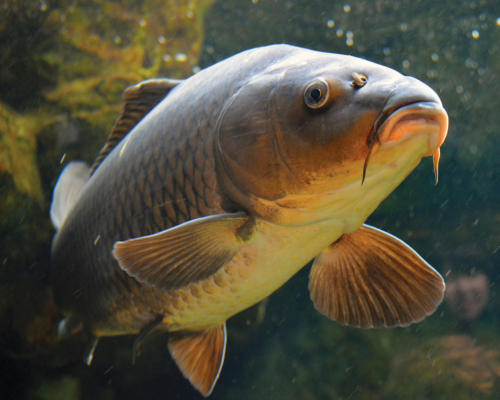
Carp
Carp fish are currently that most popular target species of bank anglers all over South Africa. They are found in dams and
river throughout Southern Africa. The 3 most familiar species of carp found in SA are the Common Carp, the Mirror Carp
and the Grass Carp. The common and mirror carp look identical with the exception of their scale arrangement. The Mirror
carp only has scales along the outside edge of the body, and along the centre of its body it has a few extra large scales.
The common carp and the grass carp on the other hand have scales all over their bodies. The grass carp look very different
from the other two types of Car. They have long bodies with slightly flattened heads. The common and mirror carp, can
grow to up to 50kgs.
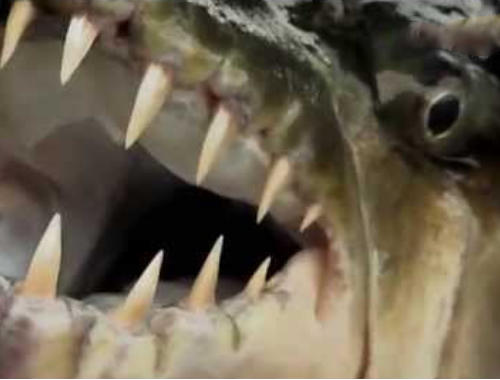
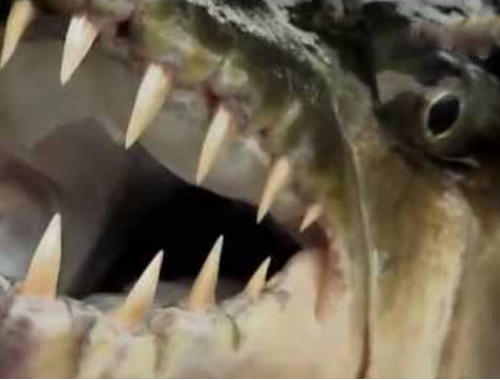
Tigerfish
The two most common species are probably most recognizable in Southern Africa. The first is the Goliath Tigerfish, reputed
to reach 50kg in weight and found in the Congo River System is the largest of the family. The second-largest, scaling up to
15kg, and the most southern species, is the Tigerfish commonly found in the Okavanga Delta, the Zambesi River and in the
two biggest lakes along the Zambesi, namely Lake Kariba and Cabora Bassa, and the Jozini Dam in South Africa.
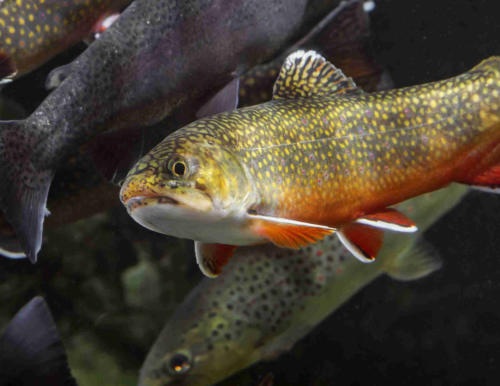
Trout
The common name is Rainbow Trout. Its length is 30 - 75 cm in length and the average weight is 1.5 to 2 kg.
Rainbow Trout can be found in streams, dams, and flowing rivers, throughout South Africa, namely Western Cape, Kwa-Zulu
Natal, Limpopo Province, Eastern Cape and Mpumalanga. They prefer colder water and breed in flowing water systems.
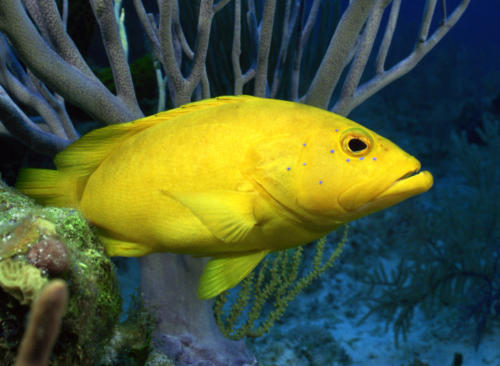
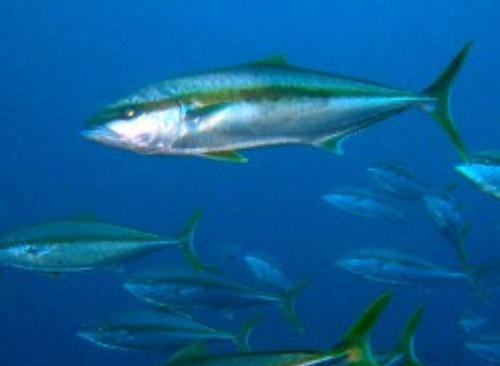
Yellowfish
The name derives from their color, which varies, from a silver sheen with just the slightest touch of gold in their iridescent
scales to the rich yellow-golden color of butter. A variety of species are found in river systems across the Southern Africa,
seven of them in South Africa. Yellowfish move in pods up into riffles and feed on larva/pupa patterns.
SALT WATER OCEAN FISHING
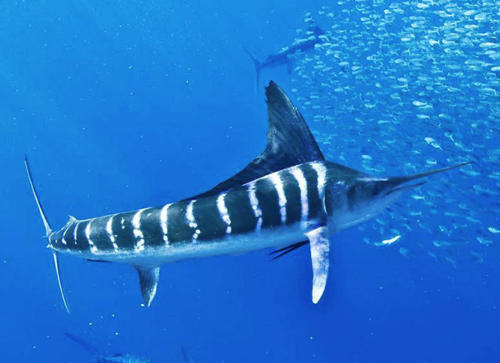
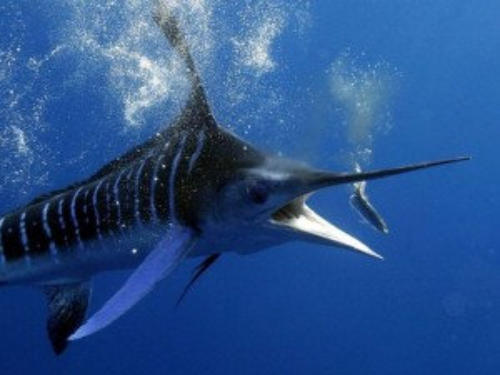
Black & Striped Marlin
A fish species that is easy to identify by the long bill, hence the general name “Billfish”. The Marlin has a rough round sword,
which is used in defense and to stun or impale prey.
The striped marlin has the most pronounced vertical line system: generally fourteen to twenty vertical stripes from the true
gill plate to the caudal peduncle. The stripes are prominent lavender to blue in colour and they appear wider than the stripes
on sailfish and seem to be made up of various size dots to form lines. The striped can "light up" to a brilliant lavender to
purple.
The other marlin have the ability to "light up" but not to the same intensity as the striped marlin. The body scales are
covered with a layer of heavy skin so they are not easily seen. The scales are single or unbranched, similar to the black
marlin's, only smaller.
The body colour of the black marlin is metallic blue-black with a white belly. It has a relatively short, round bill with the
lower jaw curving downwards. The pectoral fins are curved and cannot be moved in fish larger than 55 kg. The tail is
semicircular in adults and the lateral line is not visible.
They are distributed throughout tropical and sub-tropical waters of the Indo-Pacific. They are highly migratory and often
found close to land in water less than 200m deep. Black marlin are most common off KwaZulu-Natal during summer,
especially around submarine canyons that reach close to the shore.
This fast predator will eat virtually any fish, especially tuna, bonito and kingfish. The prey is either slashed with or impaled
by the bill.
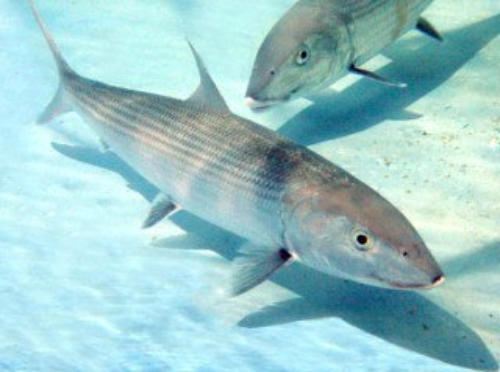
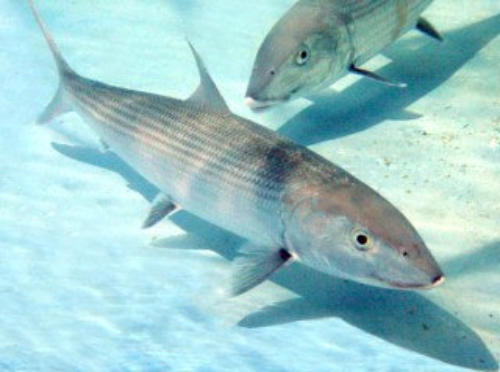
Bonefish
Large bonefish are a bluish in color above and bright silvery on both sides and below, there are dark streaks between rows of
scales. They have a slender body, rounder, and less compressed in large bonefish. Dorsal fins somewhat elevated anteriorly
and closer to the tip of Snout. Caudal fins are deeply forked, the upper lobe somewhat longer than the lower. Anal fins very
small close to the base of the caudal.
Bonefish are primarily a shallow-water species, mostly on flats or intertidal areas adjacent to sand and coral islands or
mainland beaches. Bonefish generally come onto the flats on a flood tide and drop back to deeper waters on the ebb. This
requires some good local knowledge to determine which flats the schools favour.
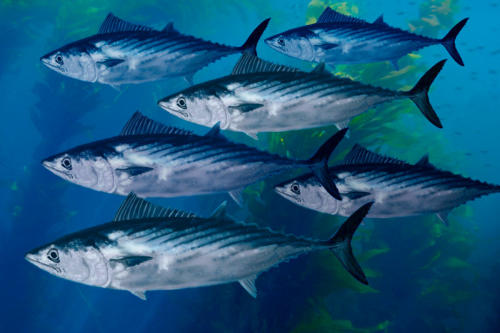
Bonito – Also known as Skipjack Tuna Striped Bonito, is a strong fighting species of Tuna found from East London all the way
up the South African coast line and into Mozambique. These species often occur in large shoals along with other saltwater
fish species.The Bonito is one of the few sea fish, that leap continually out of the water. The body is round with pointed
snout.
The upper body is dark blue to black. The lower body is silver with four to six long dark stripes. It has short pectoral fins.
Bonito
Bonitos are a tribe of medium-sized, ray-finned predatory fish in the family Scombridae – a family it shares with the
mackerel, tuna, and Spanish mackerel tribes, and also the butterfly kingfish.[1] Also called the Sardini tribe, it consists of
eight species across four genera; three of those four genera are monotypic, having a single species each.
Cape Snoek
The Cape Snoek is a long thin perch-like fish. It is found in the seas of the Southern Hemisphere. It can grow up to 200 cm,
and can weigh as much as 6 kilograms. It is found near continental shelves and or around islands and feed on crustaceans
and small fish like anchovy or pilchards. This species will form schools near the bottom or midwater. It prefers sea water
temperature between 13°C and 18°C.
It is found off the coast of Namibia and the coasts of the Northern and Western Provinces of South Africa.
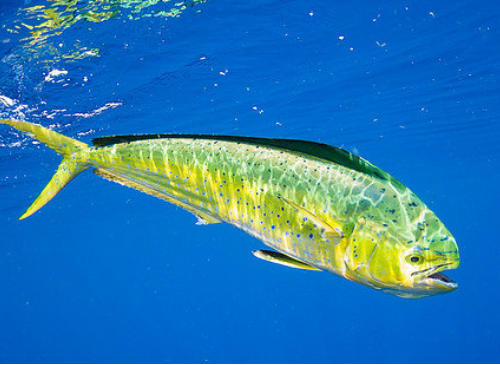
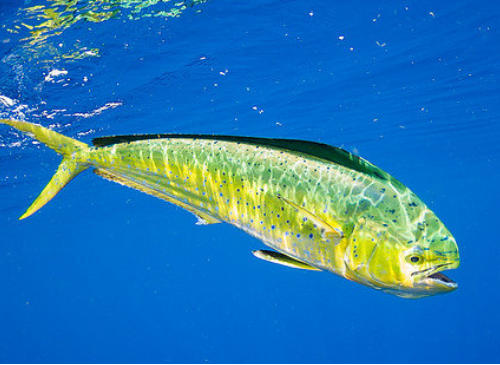
Dorado – Also known as Dolphinfish
The Dorado is recognized all over the Seven Seas as one of the best big game fish. The Dorado is a blue-green colour with
spots and blotches of various other colours. Dorado do not normally exceed 100 centimeters but the occasional fish can
attain well over 200 cm. This deep water game fish normally occurs in pairs and it is pelagic. In South Africa there are no
specific catch restrictions for the Dorado. A Dolphinfish’s diet includes mainly small fish (They do have a liking for the Trigger
fish species) and planktonic organisms. Feeding takes place in the hours of sunlight, normally very close to the surface.
This is why Dorado are caught with lures and baits trawling along the top of the ocean water.
Elf – Also known as Bluefish
In South Africa, this fish is known as “Shad” on the East Coast and as “Elf” on the West Coast. This fish is a moderately
proportioned fish, with a broad forked tail. The spiny first dorsal fins, is normally folded back in a groove, as are its pectoral
fins. It is a greyish blue-green colour, fading to white on the lower sides and belly. Its’ single row of teeth in each jaw are
uniform in size, knife-edged and sharp. They commonly range in size from 18 cm to as much as 18 kg, though fish larger
than 9 kg are exceptional.
Bluefish are extremely aggressive, and will often chase bait through the surf zone, and literally onto dry beach. Thousands
of big bluefish will attack schools of hapless baitfish in mere inches of water, churning the water like a washing machine.
This behavior is referred to as a "bluefish blitz". Baitfish, such as bunker, will willingly run themselves high and dry on the
sand, where they will suffocate, rather than be shredded by the marauding bluefish schools.
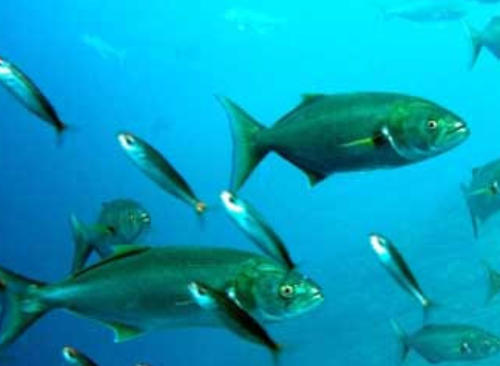
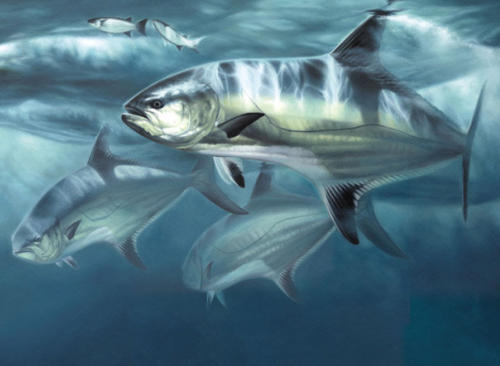
Garrick – Also known as Leervis
This fish is a coastal species that is normally found in the surf zone. They have been seen at depths of around 50 meters.
Garrick occurs along the entire South African coast from Kosi Bay around the Cape and up the west coast of Africa and in the
Mediterranean.
They are large and elongate with a slightly pointed snout. They are silver in colour with a white belly and dusky to blue grey
flank, dorsal area and fins.
Juveniles less than 10 cm in length have orange-yellow and black crossbands. The mouth has many bands of very fine teeth
which feel like sandpaper. The wavy lateral line is conspicuous on the flanks. Garrick often form small shoals which hunt
behind the backline off beaches and rocky points. It is an aggressive predator showing preference for shad and pinkies.
Garrick have been known to trap a shoal of bait fish in a gully and systematically eat them.
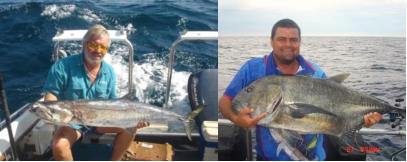
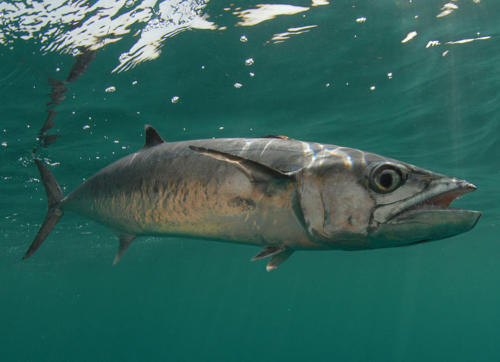
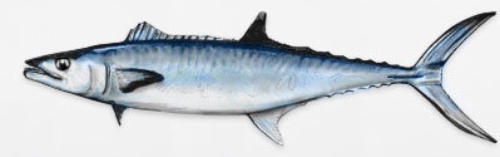
King Mackerel
The King Mackerel is a slender silver fish, only slightly compressed (flattened) from side to side with indistinct bars or spots
on its side. The dorsal surface is black with iridescent tones of blue and green. Young fish have small bronze spots in 5 or 6
irregular rows.
The King Mackerel lives in wide ranging, migratory, moves along current lines, continental shelf drop off, deep reefs and
canyons. They are also found around bait fish and floating debris.
Like other members of this genus, king mackerel feed primarily on fishes. They prefer to feed on schooling fish, but also eat
crustaceans and occasionally molluscs.
Kingfish
They are also known as Giant kingfish, Blue kingfish, Golden Kingfish and Bigeye Kingfish.
There are a number of species of kingfish, most of which are swift predators and occur in schools. They are distributed
throughout the world´s tropical and warm temperate waters and are generally found in inshore coastal waters, including the
surf zone, estuaries, rocky and coral reefs.
There are 54 species of kingfish known in South African waters, many are important game and trophy fish. Spawning of most
species does not occur in South Africa but off tropical East Africa
All kingfish species are Red-listed no-sale species, this means that it is illegal to sell or buy these species anywhere in South
Africa. These species are specifically reserved for recreational fishers and may only be caught by fishers in possession of a
recreational permit. These fishers must also abide by the recreational permit conditions which include daily bag limits and
minimum size limits. Recreational fishers are not allowed to sell their catch as this would result in unsustainable amounts of
effort being used in the fishery and undermines the livelihoods of legitimate commercial fishermen who rely on the resource
for their income.
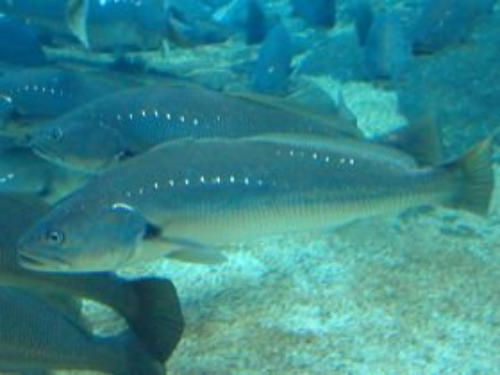
Kob
This South African fish is one of the most well known saltwater species that occur in the oceans of South Africa and because
this is the case, it has quite a few common names: Kob, Daga, Daga Salmon, Drum and Kabeljou.
The Kob is a predatory fish that moves around in shoals. The Daga occurs in water of up to 400 meters deep! The South
African Kob is a very versatile fish as it can be found in those great depths as well as in estuaries, along sandy beaches and
even amongst rocky areas off the beach. The Kob is a very good night hunter as it uses its sense of smell combined with its
lateral line to detect prey. The Kabeljou (Dusky Kob) is found along the entire coastline of South Africa and feeds mainly on
small fish, squid, cuttlefish, prawn and crabs. The Drum is a beautiful fish and a very good angling and eating fish.
Queen Mackerel
They are also known as Spotted Mackerel and Natal Snoek
This elongated torpedo shaped fish, is blue-grey above with silver sides and a white belly. Horizontal, broken lines and spots
pattern the flanks.
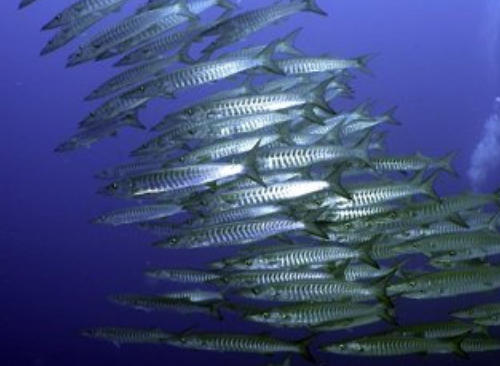
This game fish swim in shoals and are found in coastal waters, especially near rocky and coral reefs. They hunt anchovy and
small fish as well as squid and mantis shrimps.
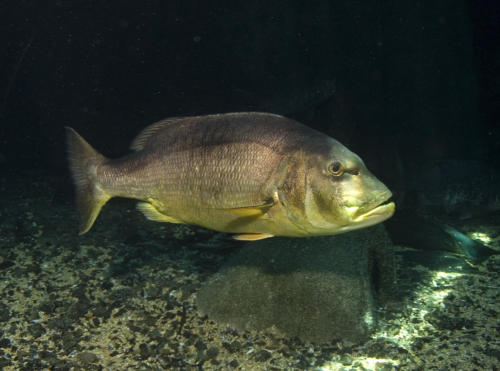
Red Steenbras
This is the largest member of the family seabreams occurring in South African waters. Colouration is a light red above, and
yellow below. Juveniles have a dark red spot on the base of the tail which disappears with age. Adult females are generally a
uniform copper colour while males develop a black coloured back and upper lip. Red steenbras have a formidable set of
canines in both the upper and lower jaws.
Red steenbras are endemic to South Africa and occur from Cape Vidal to Cape Point. They inhabit rocky reefs at depths from
10 to 160 m. Juvenile red steenbras are predominantly found in the southern Cape while adults tend to migrate northwards
towards the former Transkei and KwaZulu-Natal. Larger specimens are generally found in water deeper than 50 m, often
close to the edge of the continental shelf.
Red steenbras are voracious predators feeding on small fish, octopus and squid. They appear to be territorial during certain
stages of their life history and act as important predators in reef ecosystems.
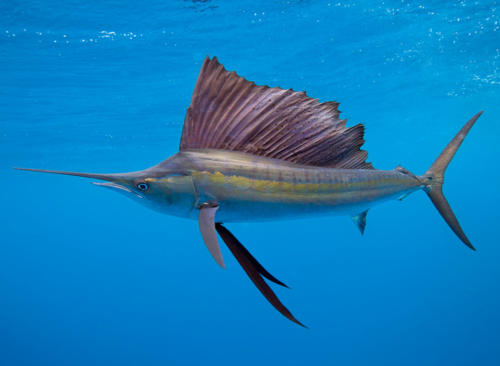
Sailfish
The sailfish is very fast. Its predatory behaviour and its body structure demonstrate its capacity for speed. Like the nose of
a jet its rapier-like bill has been shown to cause what is called low-resistance flow or in other words, hydro dynamics.
It is related to the Marlin and Swordfish. They are blue to gray in color with white underbellies. They get their name from
their spectacular dorsal fin that stretches nearly the length of their body and is much higher than their bodies are thick.
They are found near the ocean surface usually far from land feeding on schools of smaller fish like sardines and anchovies,
which they often shepherd with their sails, making them easy prey. They also feast on squid and octopus.
Swordfish
Swordfish are large, highly migratory, predatory fish characterized by a long, flat bill in contrast to the smooth, round bill
of the marlins. Swordfish are elongate, round-bodied, and lack teeth and scales as adults. They reach a maximum size of
4.3 m and 540 kg.
The swordfish is known as The Gladiator because of the sharp, sword-like bill it wields as a weapon – to spear prey as well
as for protection from its few natural predators. The mako shark is one of the rare sea creatures big enough and fast
enough to chase down and kill an adult swordfish.
Yellowfin Tuna
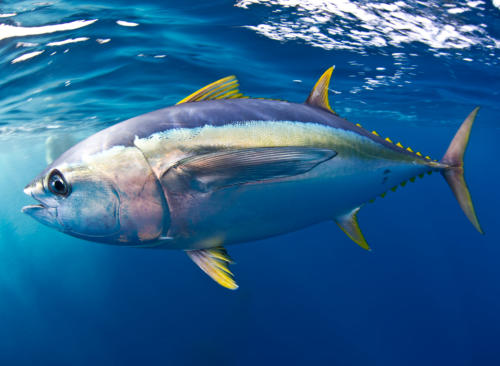
Yellowfin tuna are torpedo-shaped with dark metallic blue backs, yellow sides, and a silver belly. They have very long anal
and dorsal fins that are bright yellow, as are their finlets. Yellowfin can live up to 6 or 7 years, grow to a length of 2m and
weigh 200kg. Yellowfin are highly migratory and are found throughout the Pacific, Atlantic and Indian Oceans (between 40
degrees north and 40 degrees south but concentrated between 20 degrees north and 20 degrees south). Yellowfin tend to
school by size with other yellowfin as well as with other species. Juvenile yellowfin, for example, form schools with skipjack
tuna and juvenile bigeye tuna in shallow waters.
species top










© Tusks and Tracks Africa : Design


Fishing Species Available
Make your selection and then Contact Us for
a quotation

Inland Fishing
Bass
Carp
Tiger Fish
Trout
Yellow Fish
Saltwater Ocean Fishing
Kingfish
Kob
Queen Mackeral
Red Steenbras
Sailfish
Swordfish
Yellowfin Tuna

Saltwater Ocean Fishing
Black & Striped Marlin
Bonefish
Bonito
Cape Snoek
Dorado
Elf
Garrick
King Mackeral