

© Tusks and Tracks Africa : Design
Species Available to Hunt - page 1


African Wild Cat
Baboon
Black Wildebeest
Blesbuck
Blue Wildebeest
Bushbuck
Buffalo
Bushpig
Caracal
Civets
Common Duiker
Common Reedbuck
Crocodile
Eland
Elephant
Gemsbuck
Genet
Giraffe
Hippo
Hyena
Impala
Jackal
Klipspringer
Kudu
Lechwe
Leopard
Lion
Mountain Reedbuck
Nyala
Ostrich
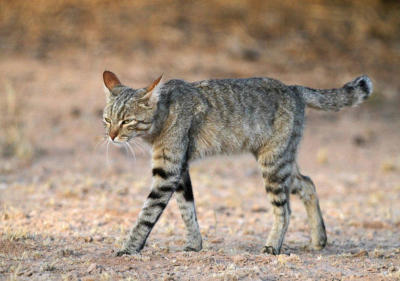
African Wild Cat
The African wildcat, also known as the desert cat, is a subspecies of the wildcat. The African wildcat eats primarily mice, rats
and other small mammals. When the opportunity arises, it also eats birds, reptiles, amphibians, and insects. The cat
approaches its prey slowly, and attacks by pouncing on its prey as soon as it is within range (about one meter). The African
wildcat is mainly active during the night and twilight. When confronted, the African wildcat raises its hair to make itself seem
larger and intimidate its opponent. In the daytime it usually hides in the bushes, although it is sometimes active on dark,
cloudy days. The territory of a male overlaps with that of a few females, and he defends the territory against intruders. A
female gives birth to two to six kittens, with three, being average. The African wildcat often rests and gives birth in burrows
or hollows in the ground. The gestation lasts between 56 and 69 days. The kittens are born blind and need the full care of
the mother. Most kittens are born in the wet season, when there is sufficient food. They stay with their mother for five to six
months and are fertile after one year.
The African Wild cat is sandy brown to yellow-grey color, with black stripes on the tail.
The fur is shorter than that of the European species. It is also considerably smaller: the head-body length is 45 to 75cm
(17.7 to 29.5 inches), the tail 20 to 38cm (7.87 to 15 inches) and the weight ranges from 3 to 6.5 kg (6.61 to 14.3 lbs).
The African Wild Cat is commonly found in Africa and in the Middle East, in a wide range of habitats: savannas and bushland.
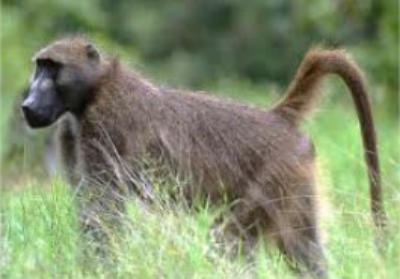
Baboon
Baboons are terrestrial (ground dwelling) and are found in open savannah, open woodland and hills across Africa. Their diet
is omnivorous, but mostly vegetarian; yet they eat insects and occasionally prey on fish, shellfish, hares, birds, vervet
monkeys, and small antelopes. They are foragers and are active at irregular times throughout the day and night. They can
raid human dwellings and in South Africa they have been known to prey on sheep and goats.
Their principal predators are humans, the lion, both the spotted and striped hyena and the leopard. They are however
considered a difficult prey for the leopard, which is mostly a threat to young baboons. Large males will often confront them
by flashing their eyelids, showing their teeth by yawning, making gestures, and chasing after the intruder/predator.
Baboons in captivity have been known to live up to 45 years, while in the wild their life expectancy is about 30 years
The Baboon inhabits dry forests, gallery forests, and adjoining bush savannas or steppes. The most common Baboon found
in South Africa is the Chacma baboon.
They are social with a strong family structure, with one dominant male per troop. They are not territorial, but will move
long distances in search for food. It is brown to black hair, a hairless dark violet or black face with a typical dog-like face.
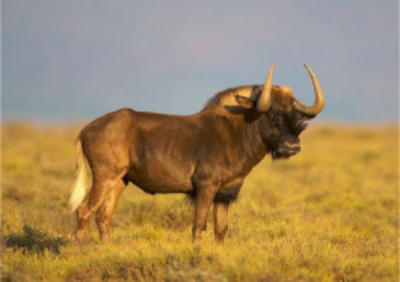
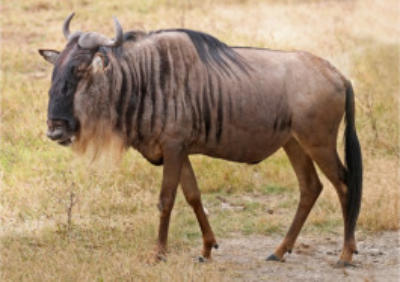
Black Wildebeest
The Black Wildebeest or White-tailed Gnu is one of two wildebeest species. The natural populations of this species, endemic
to the southern part of Africa, have been almost completely exterminated, but the species has been reintroduced widely, both
in private areas and nature reserves throughout most of Lesotho, Swaziland, South Africa, Namibia and Kenya. It was also
introduced outside its natural range (Wilson & Reeder, 1993; East, 1989, 1996). The primal herds were exterminated, being
seen as pests, with the secondary advantage of using the hides and meat. Thus this animal exists primarily in herds derived
from captive specimens.
Its preferred habitat types are grassveld savanna and Karoo of the central South Africa plateau.
It has a beefy muscular front-heavy appearance with a distinctive robust muzzle. It strides with relatively slender legs and
moves gracefully and quietly most of the time.
The Black Wildebeest is one of two wildebeest species. The natural populations of this species, endemic to the southern part
of Africa, have been almost completely exterminated. The species has been reintroduced widely, both in private areas and
nature reserves in South Africa.
Blesbuck
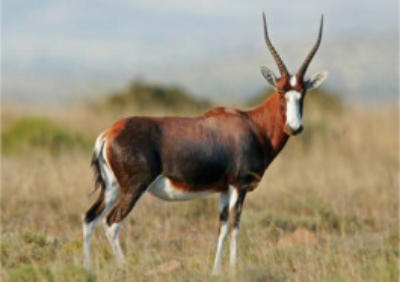
The Blesbok or Blesbuck is an antelope with a distinctive white face and forehead. Its white face is the origin of its name,
because bles is the Afrikaans word for blaze. Although it is a close relative of the Bontebok and can interbreed with it,
creating an animal known as the Bontebles or Baster Blesbok, it does not have the same habitat. The Blesbok is indigenous
to South Africa and is found in large numbers in all national parks with open grasslands, from the Transvaal Highveld,
through the Free State veld, to as far south as the Eastern Cape. It is a plains species and dislikes wooded areas. It was
first discovered in the 17th-century, in numbers so numerous that herds reached from horizon to horizon.
The neck and the top of the back of the Blesbok is brown. Lower down on the flanks and buttocks, the coloring becomes
darker. The blesbok, a South African antelope, is almost the same color as grapejuice! The belly, the inside of the buttocks
and the area up to the base of the tail is white. Blesbok can be easily differentiated from other antelopes because they have
a distinct white face and forehead. The legs are brown with a white patch behind the top part of the front legs. Lower legs
whitish. Both sexes have horns, female horns are slightly more slender. The Blesbok differ from the Bontebok by having less
white on the coat and the blaze on the face and which is usually divided. Their coats are also a lighter brown than that of the
Bontebok. The length of their horns averages at around 38 cm. Male adult Blesbok average around 70 kg, female average
lower, at around 61 kg.
The Blesbuck is a purplish antelope with a distinctive white face and forehead. Its white face is the origin of its name
because bles is the Afrikaans word for blaze.
The Blesbuck is indigenous to South Africa and is found in large numbers in all South African national parks with open
grasslands.
Blue Wildebeest
The name “Blue Wildebeest” derives from a conspicuous silvery blue sheen to its short haired hide, differentiating this
species from the plainer black genus member Black Wildebeest.
The Blue Wildebeest, also called the Common Wildebeest, is a large antelope and one of two species of wildebeest. It grows
to 115-145cm shoulder height and attains a body mass of 168-274 kg. They range the open plains, bushveld and dry
woodlands of Southern and East Africa. They have a life span in excess of twenty years. This herbivore is a grazing animal
that is often sighted in open grasslands or clearings in a savanna. The male is highly territorial, using scent markings and
other devices to protect his domain. The largest population is in the Serengeti, numbering over one million animals.
Bushbuck
The bushbuck is the most widespread antelope in Sub-Saharan Africa, and is found in rain forests, montane forests, forest-
savanna mosaics and bush savannah forest and woodland. Recently, genetic studies have shown that the bushbuck, is in fact
a complex of two geographically and phenotypically distinct species. The most compelling evidence for the division of the
bushbuck into the Kéwel and the Imbabala is that both species are more closely related to other members of the tragelaphine
family (the Imbabala to the Bongo and the Sitatunga, and the Kéwel to the Nyala) than to each other. The bushbuck ram is
regarded by sports hunters as the most dangerous medium-size antelope, as it will hide in the bush after being wounded and
charge the hunter when he comes looking for it, impaling the hunter with its sharp horns.
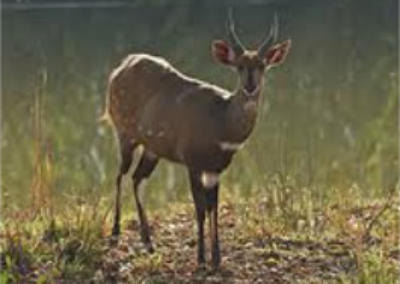
The very sharp horns render the Bushbuck very dangerous when wounded. The Bushbuck is a close relative of the Kudu and
the Nyala. The rams are very elegant in appearance, sporting dark greyish-brown fur, with white spots on the flanks and
prominent white socks. In height they are 700mm at the shoulders, and have a maximum mass of 54 Kg's.
Bushbuck eat mainly browse but supplement their diet with any other plant matter they can reach.
Bushbuck are active around 24 hours a day, but tend to be nocturnal near human habitations. Bushbuck tend to be solitary,
though some live in pairs. All bushbuck live within a “home” area. These areas usually overlap other bushbuck home areas.
Bushbuck are basically solitary animals and the mature males go out of their way to stay away from each other.
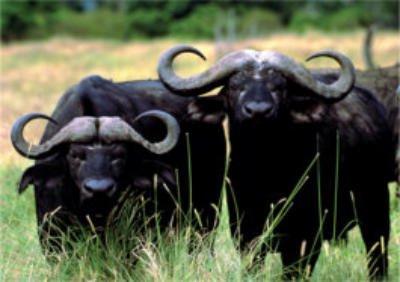
Buffalo
The African buffalo is one of the most successful grazers in Africa. It lives in swamps, floodplains as well as mopane
grasslands and forests of the major mountains of Africa. Buffalo prefer habitat with dense cover such as reeds and thickets.
Herds have also been found in open woodland and grassland. While not particularly demanding with regard to habitat, they
require water daily and therefore depend on perennial sources of water.
The Cape buffalo is a very robust species. Savannah type buffalo have black or dark brown coats and their horns are curved
to a closed crescent. Forest type buffalo are reddish brown in color with horns that curve out backwards and upwards.
Calves of both types have red coats. The Cape buffalo is one of the most successful grazers in Africa. It lives in swamps,
floodplains as well as mopane grasslands and forests of the major mountains of Africa. Buffalo prefer habitat with dense
cover such as reeds and thickets. Herds have also been found in open woodlands and grasslands.
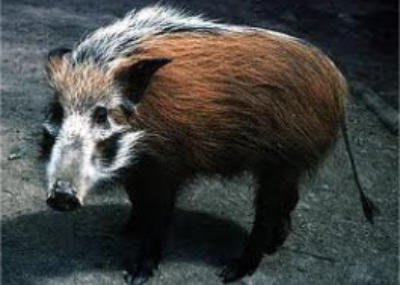
Bushpig
The Bush Pig is a strong, stocky pig with powerful forequarters. Its upper tusks are barely visible, but the lower tusks are
razor sharp and grow to 7cm in length. It is very dangerous when surprised in the bush or wounded during hunting, it can
inflict serious wounds with the sharp, protruding canines. An adult boar measures up 900mm at the shoulder and can weigh
as much 60 Kgs.
The Bushpig is a member of the pig family that lives in forests, woodlands, riverine vegetation and reedbeds in East and
Southern Africa. Bushpigs vary greatly in color throughout their range. Seldom seen, but easily identified by their ominous
harsh grunt and pig like appearance. This wily night-time raider with an appetite for domestic crops, infuriates farmers with
destructive forages into nearby farmlands.
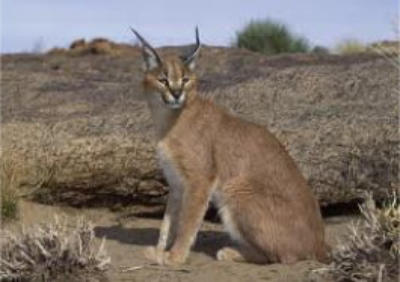
Caracal
The colour of the fur varies between wine-red, grey, or sand-coloured. Melanistic (black) caracals also occur. Young caracals
bear reddish spots on the underside; adults do not have markings except for black spots above the eyes and small white
patches around the eyes and nose. Underparts of chin and body are white, and a narrow black line runs from the corner of
the eye to the nose.
The Caracal is distributed over Africa and the Middle East. Its chief habitat is dry steppes and semi deserts, but it also
inhabits woodlands, savannah, and scrub forests. They generally prefer open country, so long as there is sufficient cover, in
the form of bushes and rocks, from which to hide. The Caracal is a slender, yet muscular cat, with long legs and a short tail.
Males typically weigh 13 to 18 kilograms (29 to 40 lb), while females weigh about 11 kilograms (24 lbs). Compared to
lynxes, it has longer legs, shorter fur and a slimmer appearance.
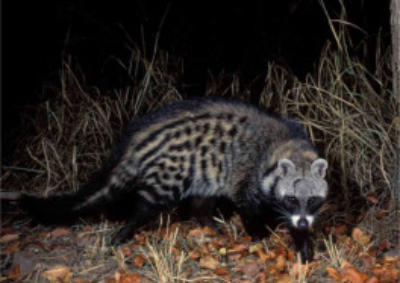
Civet Cat
The civet produces a musk (also called civet) highly valued as a fragrance and stabilizing agent for perfume. Both male and
female civets produce the strong-smelling secretion, which is produced by the civet's perineal glands.
Civet Cats have a broadly cat-like general appearance, though the muzzle is extended and often pointed, rather like an otter
or a mongoose. They range in length from about 17 to 28 in (43 to 71 cm) (excluding their long tails) and in weight from
about 3 to 10 lb (1.4 to 4.5 kg). Favored habitats include woodland, savanna, mountain biomes and tropical rainforest.
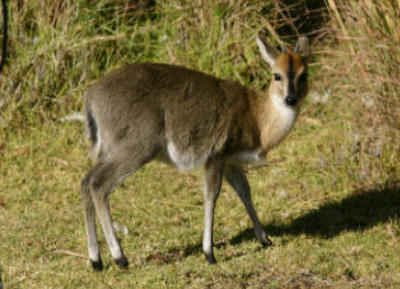
Common Duiker
It grows to about 20 inches (50 cm) in height and generally weighs 12 to 25 kg; although females are generally larger and
heavier than their male counterparts. The male bears horns which can grow to 4.25 inches (11 cm) long. Breeding is year
round and the female gives birth to one fawn after a gestation period of what is variously estimated at 3 to 7.5 months.
The common duiker has a wide diet; beyond herbivorous browsing for leaves, flowers, fruits and tubers, they will also eat
insects, frogs, small birds and mammals and even carrion. As long as they have vegetation to eat (from which they get
some water), they can go without drinking for very long periods of time. In the rainy season they will frequently not drink
water at all, instead obtaining fluids from fruits. They will often scavenge for these fruits below trees in which monkeys are
feeding. They are active both day and night.
Common Duiker, also known as the Gray or Bush Duiker, is a small antelope with small horns found everywhere in Africa,
south of the Sahara, excluding the horn of Africa and the rainforests of central and western parts of the continent. Generally
they are found in habitat that has sufficient vegetation cover to allow them to hide – savannah and hilly areas, including the
fringes of human settlements.
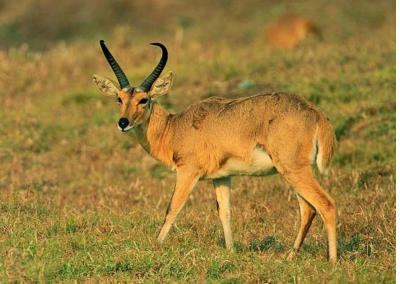
Common Reedbuck
Reedbucks average 85 cm at the shoulder and weigh around 70 kg. Reedbuck live in valley and upland areas, where they eat
grasses and reeds. They have grey-brown coats with a white underbelly and black forelegs. Males have ridged horns of
around 35 cm, which grow backwards and then curve forwards. Common Reedbuck are an antelope of the open grass plains,
often found near water. They usually occur in groups of 3 – 6 animals or are solitary. Territories are occupied by pairs that
communicate by the species characteristic whistling call. They tend to graze at night when food is abundant, but can often
be seen in the late afternoon or early morning. When left undisturbed, they will become very tame, often venturing into
farmers’ gardens at night.
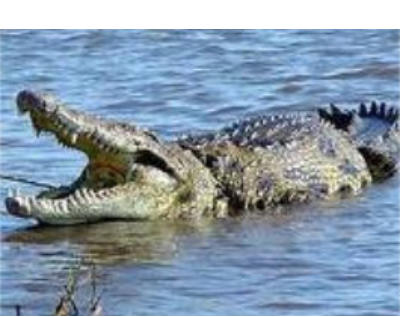
Crocodiles
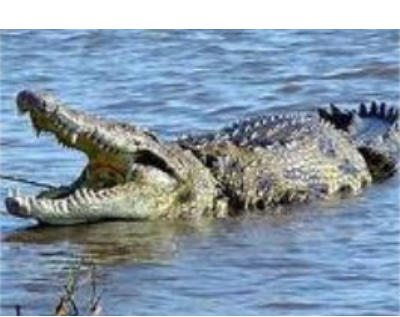
A crocodile’s physical traits allow it to be a successful predator. They have a streamlined body that enables them to swim
swiftly. Crocodiles also tuck their feet to their sides while swimming, which make them faster by decreasing water resistance.
They have webbed feet which, although not used to propel the animal through the water, allow it to make fast turns and
sudden moves in the water or initiate swimming. Webbed feet are an advantage in shallower water where the animals
sometimes move around by walking.
Crocodiles are very fast over short distances, even out of water. Since crocodiles feed by grabbing and holding onto their
prey, they have evolved sharp teeth for tearing and holding onto flesh, and powerful muscles that close the jaws and hold
them shut. These jaws can bite down with immense force, by far the strongest bite of any animal.
Crocodiles are large aquatic reptiles that live throughout the tropics in Africa, Asia, the Americas and Australia. Crocodiles
tend to congregate in freshwater habitats like rivers, lakes, wetlands and sometimes in brackish water. They feed mostly
on vertebrates like fish, reptiles and mammals. Bony plates, called osteoderms, form a kind of armor in their thick skin.
Their teeth, about 30 to 40 ins in each jaw, are set into sockets in the jawbone and interlock when the mouth is closed.
On land, crocodilians move quickly in a belly crawl but can also gallop and walk mammal-like on all four legs.
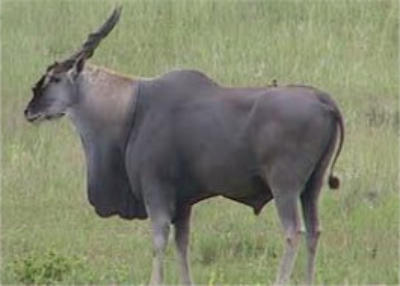
Eland
The Eland is the world's largest antelope. Males have twisted horns which are thick and tightly spiralled, growing up to 25"
in females and to 50" in males. Eland belong to the same group as kudus, nyala and bushbuck. Eland are found in grassland,
mountain, sub-desert, acacia savannah and woodland areas.
Herbivorous, they feed in areas where shrubs and bushes provide the leaves they prefer. They use their horns to bring twigs
and branches into reach. They are also known to consume tuberous roots.
The Common Eland is considered the largest species of “antelope”, though in many respects, the Elands are quite bovine.
The females have a tan coat, while the males have a darker tan coat with a blueish-grey tinge. There may also be a series
of white stripes vertically on the sides of bulls (mainly in parts of the Karoo in South Africa). Males have dense fur on their
foreheads and a large dewlap. Both sexes have horns, with a steady spiral ridge (resembling that of the bushbuck). The
female’s horns are wider set and thinner than the male’s. They eat branches, leaves and berries.
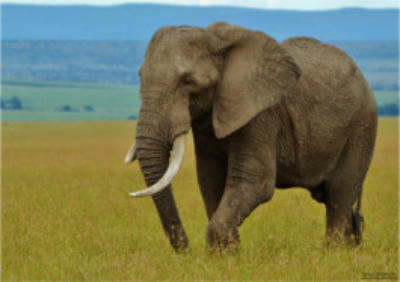
Elephant
African elephants are distinguished from Asian elephants in several ways, the most noticeable being their much larger ears.
Also, the African elephant is typically larger than the Asian elephant and has a concave back
It is the largest land animal, with males standing 3.2 meters to 4 meters at the shoulder and weighing 3,500 kilograms up
to a reported 12,000 kilograms The female is smaller, standing about 3 meters at the shoulder. Most often, savannah
elephants are found in open grasslands, marshes and lakeshores. They range over much of the savannah zone south of
the Sahara.
Elephants are the largest land animals. The elephant has a very thick skin, which may reach a thickness of 3 – 4 cm.
African elephants have five well-formed digits on both fore and hind feet. Elephants move in family groups, crashing
through the forest, tearing down trees and shrubs for food and the cycling back later on, when the area has re-grown.
The African elephant are found in most parts south of the Sahara. Their body and ivory sizes vary from country to country,
due to the different habitations they survive in.
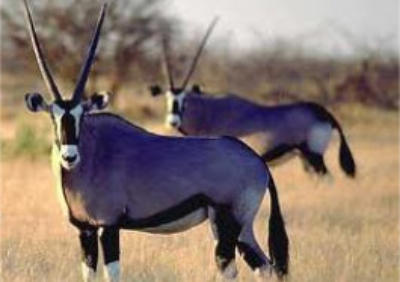
Gemsbuck
The Gemsbok or Gemsbuck is a large antelope. It is native to the arid regions (for example the Kalahari Desert) of Southern
Africa. The name derives from the Dutch name of the male chamois, gemsbok. Although there are some superficial
similarities in appearance (especially in the colour of the face), the chamois and the oryx are not closely related.
Gemsbuck are light brownish-grey to tan in color, with lighter patches to the bottom rear of the rump. Their tails are long
and black in color. Both genders have long straight horns. Gemsbuck live in herds of about 10 – 40 animals, which consist
of a dominant male, a few non-dominant males and females. The Gemsbuck prefers the arid and semi-arid open grassland,
scrub and light open woodland. It is very adapt for desert and semi-desert life with the ability to go for extended periods
without water. Occasionally they do penetrate deep into savannah woodlands searching for new feeding grounds in the more
open areas within them.
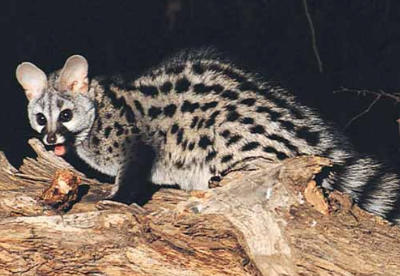
Genet
Genets are highly agile creatures, with quick reflexes and exceptional climbing skills.
Most of them have spotted coats and long banded tails, small heads and large ears. Like civets, genets have strong musk
glands, which are used to mark territory, and they are known to perform handstands when doing this. Genets possess
extremely long tails – typically over 1 to 1.5 times the length of their bodies – providing a highly effective counter-weight
that enables them to easily maintain balance as they leap from tree limb to tree limb. They live exclusively in Africa and
Northwest Africa and throughout Europe.
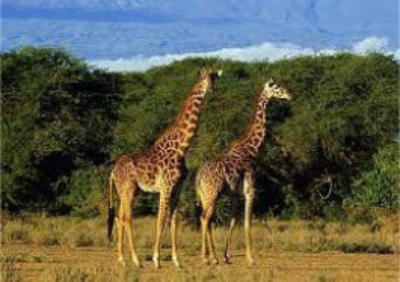
Giraffe
The giraffe is an African even-toed ungulate mammal, the tallest of all living animal species, and the largest ruminant.
The giraffe’s scientific name, which is similar to its antiquated English name of camelopard, refers to its irregular patches
of color on a light background, which bear a token resemblance to a leopard’s spots. Its range extends from Central Africa
to South Africa. Giraffes usually inhabit savannahs, grasslands or open woodlands. However, when food is scarce, they
will venture into areas with denser vegetation. They prefer areas with plenty of acacia growth.
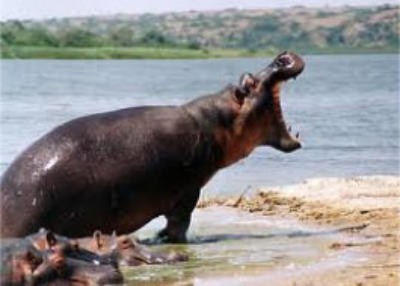
Hippo
The hippopotamus’ proportions reflect its sedentary, amphibious existence. Its plump and bulky body is set on short stumpy
legs, with each foot having four toes. Although webbed, the toes splay enough to distribute the weight evenly over each toe
and therefore adequately support the hippo on land.
The hippopotamus is semi-aquatic, inhabiting rivers and lakes where territorial bulls preside over a stretch of river and
groups of 5 to 30 females and young. They emerge at dusk to graze on grass. While the hippopotamuses rest near each
other in the water, grazing is a solitary activity and hippos are not territorial on land. The hippopotamus is recognizable by
its barrel-shaped torso, enormous mouth and teeth, nearly hairless body, stubby legs and tremendous size. It is the third-
largest land mammal by weight. Despite its stocky shape and short legs, it can easily outrun a human.
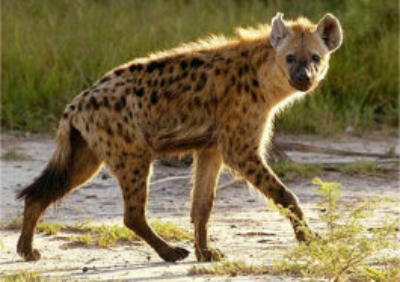
Hyena
Both hyenas and canines catch prey with their teeth rather than claws. Both eat food quickly and may store it, and their
calloused feet with large, blunt, non-retractible nails are made for running and making sharp turns. However, the hyenas'
grooming, scent marking, defecating habits, mating and parental behaviour are consistent with the behaviour of other
feliforms. Although long reputed to be cowardly scavangers, especially the Spotted Hyena, they kill as much as 95% of the
food they eat, and have been known to drive off leopards and lionesses from their kills. Hyenas are primarily nocturnal
animals, but may venture from their lairs in the early morning hours. With the exception of the highly social spotted hyena,
hyenas are generally not gregarious animals, though they may live in family groups and congregate at kills.
All species have a distinct bear-like gait, due to their front legs being longer than their back legs. The Aardwolf, Striped
Hyena and Brown Hyena have striped pelts and manes lining the top of their necks which erect when frightened.
The Spotted Hyena’s fur is considerably shorter and spotted rather than striped. Three of the four species of hyena are
restricted to sub-Saharan Africa, where they live in environments such as savannah, bushland and desert. The Striped
Hyena is found in northern and eastern Africa as well as in Asia, from the Middle East to India.
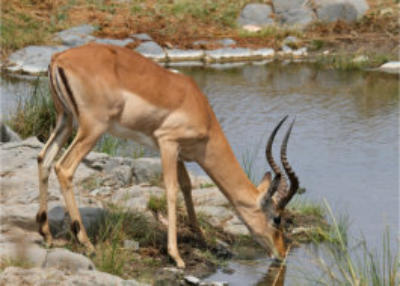
Impala
Impalas are reddish-brown with white and black markings. The ears, eyes, chin, throat, belly and buttocks are white. From
the middle of the lower back to the tail and on the back of each thigh, they have black stripes. On each hind leg above the
heel, impalas also have tufts of black hair that cover a scent gland. Known for their leaps, Impala can jump about 10 feet
high and when running, about 33 feet ahead.
They are normally reddish-brown in color, have lighter flanks and white underbellies with a characteristic “M” marking on the
rear. Males, referred to as rams, have lyre-shaped horns. Females, referred to as ewes, have no horns. Impalas are among
the dominant species in many savannahs. They can adapt to different environments by being both grazers in some areas
and browsers in others. They graze when the grass is green and growing, and browse at other times. They will browse on
shoots, seedpods and foliage.
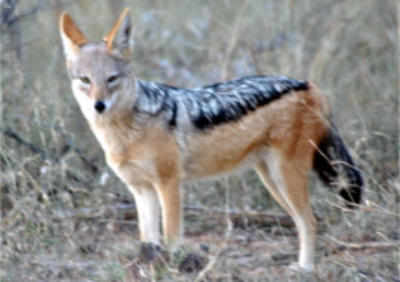
Jackal
Jackals are opportunistic feeders and will prey upon small antelope, reptiles, insects and ground-dwelling birds. They
understand the importance of fruits and vegetables and will complement their diet with berries and grasses. Although,
some jackals will form small groups, especially while scavenging a kill, they tend to be either solitary or paired up with a
mate. In fact, the jackal is one of the few mammal species that mate for life with their partner defending their territory
together.
They are omnivorous predators of small to medium-sized animals, as well as scavengers when the need be. The jackal’s
long legs and curved canine teeth are adapted for hunting small mammals. Big feet and fused leg bones give them a
physique for long-distance running, capable of maintaining speeds of 16 km/h (9.9mph) for extended periods of time.
Jackals are crepuscular, most active at dawn and dusk.
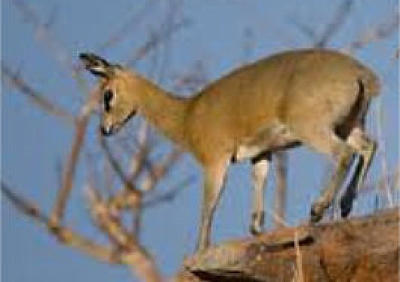
Klipspringer
A small antelope, the klipspringer stands about 20 inches tall and weighs 23-to-29 pounds; the female is heavier. The
klipspringer is the only antelope that lives on cliffs and rock outcrops. The short body has massive hindquarters and sturdy
long legs with truncated hooves. The head is wedge-shaped on a short neck, with big rounded ears. The four-inch-long
horns are wide-set, upstanding and ringed at the base. The coat is rough and the hairs are hollow, brittle and loose, which
makes for good padding and insulation. The color is grizzled yellow-brown and the ears, bordered in black, are white inside
with radiating dark lines. Huge preorbital glands, surrounded by bare, black skin, are more developed in males. There are
no hoof glands.
Klipspringers are relatively small animals compared to some of their larger antelope cousins. Only the males have horns.
They stand on the tips of their hooves. They do not have regular fur like other antelope, but rather short thick hollow spikes,
which form a thick and dense speckled “salt and pepper” patterned coat almost of an olive shade. Its coat serves as a
protection against sharp objects as it moves in rocky areas. Klipspringer have a restricted habitat preference, namely to
very rocky environments of mountainous areas and small hills. This allows this nimble-footed antelope to escape from its
predators.
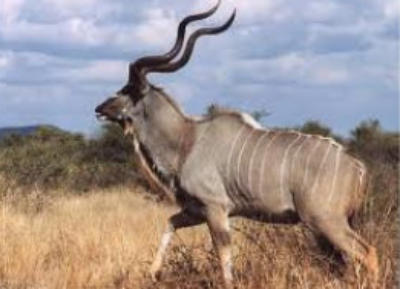
Kudu
The kudu is a herbivore that spends much of its time eating leaves from various trees and bushes. These peaceful herbivores
have several predators including lions, cheetahs, leopards and wild dogs. In order to survive the kudu usually hangs out close
to woodlands. These agile animals stand a much better chance in the dense forest then they do on the open plains. They
can usually out maneuver their predator in the bush and will eventually hide until the hungry carnivore gives up. The fancy
markings and colouring of the kudu provides excellent camouflage making them very difficult to spot.
Tall and majestic, with the most spectacular horns, Kudus are one of Africa’s most sort-after trophies. This animal certainly
ranks as one of Africa’s most handsome species. The short smooth coat varies in general color from grayish-fawn to grayish-
brown, with old bulls becoming grayer and their necks becoming darker in the breeding season. Distinctive features include
a white chevron-shaped mark extending from the eyes across the upper nose and exceptionally large pink ears. The black-
tipped bushy tail is white underneath and there are black garters on the upper legs. Preferred habitat includes mixed shrub,
woodland, acacia and bush on lowlands, hills and mountains. They are particularly partial to rugged broken country where
they have a cover of woodland and a nearby supply of water. They can survive on farms, provided sufficient cover remain.
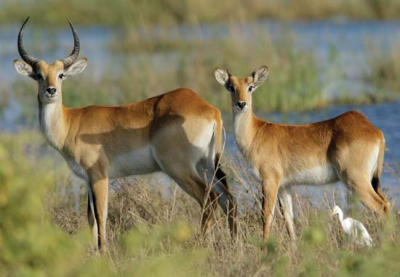
Lechwe
The Lechwe is a medium-sized antelope which is well adapted to wetlands. Males weigh about 103-118 kg, with a head-body
length of 161-169 cm. Females are smaller and lighter (about 25 %) than the males. The hindquarters are higher than
forequarters. The legs are long and slender with bare pasterns. The hooves are pointed and distinctly elongated. The dew-
claws are well-developed. The tail is fairly long, coloured like the body above and white below, the tip with a large black tuft.
The Lechwe is an antelope found in Southern Africa as far as Botswana, Zambia and Congo. They are golden-brown with a
white belly.
Males are darker in color, but general hue varies, depending on subspecies. The long spiral structured horns are vaguely
lyre-shaped.
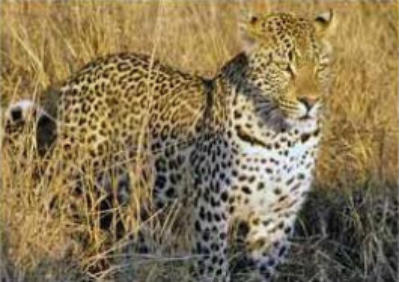
Leopard
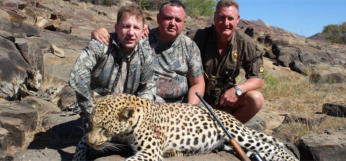
The leopard has the widest distribution of all wild cats and is the most adaptable of the big cats. Leopards can run up to 60
kilometers (37 miles) per hour, but will not chase prey for long distances. Consequently, they can lose their meal to lions,
hyenas and wild dogs. Leopards are thought to be seven times stronger than human beings and they can haul a carcass
three times their weight. They store the carcass in a tree or rocky outcropping to protect their food supply from other
predators. Leopards are famous for their ability to go undetected because of their spotted coloration.
Once distributed across eastern and southern Asia and Africa, from Siberia to South Africa, the leopard’s range of distribution
has decreased to be chiefly found in sub-Saharan Africa. The leopard has relatively short legs and a long body, with a large
skull and with a beautiful spotted fur. Leopards hide their prey in trees, where they feed on it when hungry. Since their
habitat has been reduced over decades, they have become a nuisance to cattle and sheep farmers. This has resulted in
near distinction and Leopards are thus strongly regulated by Nature Conservationists.
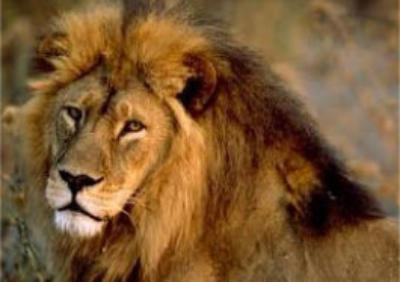
Lions
Lions are the only cats that live in groups, which are called prides. A pride is a family unit that may include up to three males,
a dozen or so females, and their young. All of a pride's lionesses are related, and female cubs typically stay with the group as
they age. Young males eventually leave and establish their own prides by taking over a group headed by another male. Only
male lions boast manes, the impressive fringe of long hair that encircles their heads. Males defend the pride's territory, which
may include some 100 square miles (259 square kilometers) of grasslands, scrub, or open woodlands. These intimidating
animals mark the area with urine, roar menacingly to warn intruders, and chase off animals that encroach on their turf.
Lion is the second largest cat after the tiger. Lions live for ten to fourteen years in the wild, whilst in captivity they can live
longer than twenty years. In the wild, males seldom live longer than ten years, as injuries sustained from continued fighting
with rival males greatly reduce their longevity. They typically inhabit savannahs and grasslands, although they may take to
bush and forest. Lions are unusually sociable compared to other cats. A pride of lions consists of related females and
offspring and a small number of adult males.
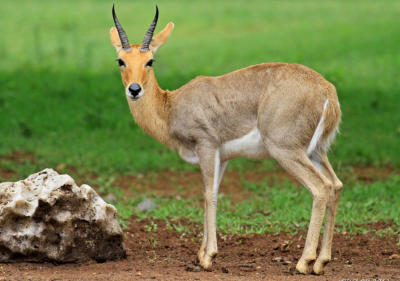
Mountain Reedbuck
The Mountain Reedbuck is a timid species of antelope that lives in the rocky slopes and mountainous terrains of northeastern
South Africa. These animals are mainly grazers with diets consisting of leaves, grasses and other plants. They also require
constant access to fresh water supplies. Full grown Mountain Reedbucks weigh about 30 kg (66 pounds). Males produce
curved horns with rings that average 30-45 cm (12-18 inches). They are approximately 80 cm (30 inches) wide at the
shoulders. They can easily be recognized by a round bare spot under each ear. These beautiful animals have gray colored
coats with bright white underbellies. Their head and shoulders are reddish-brown and they have large eyes and ears.
The Mountain Reedbuck is an antelope found in mountainous areas of much of sub-Saharan Africa. The Mountain Reedbuck
has a grey coat with a white underbelly and reddish-brown head and shoulders. The male has ridged horns which curve
forwards. The Mountain Reedbuck lives in thick mountainous forest, where it eats grasses and leaves. It forms herds of
around five individuals, including a single mature male.
Nyala
Nyala are medium sized antelopes and they have a body length between 1.4 and 1.6 m (4.5 - 5.25 ft), a tail length between
40 and 55 cms (16 - 22 inches) and they weigh between 55 and 125 kgs (120 - 280 lbs). Male Nyala are much larger and
heavier than females.
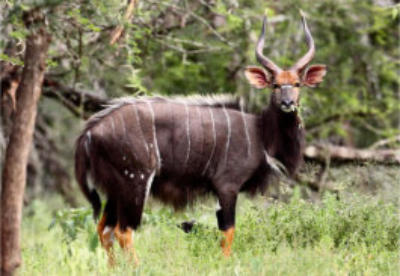
Male Nyala have a dark grey coloured head and body with indistinct stripes along their torso. Their lower legs are tan in
colour and they have have a fringe of hair along their underside and a thin crest on their back. They have horns that
measure up to 70 cm (28 inches) in length and a white “V” between their eyes.
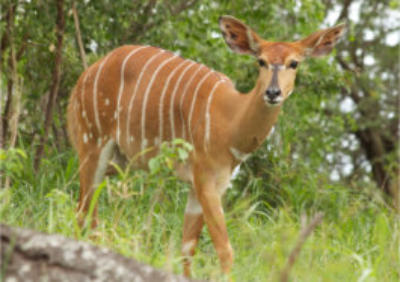
Female and juvenile Nyala are red/brown in colour and they have distinctive, vertical white stripes along their body. They do
not have any horns but they have a white "V" between their eyes.
They spend most of the day, particularly the hottest part, under the shade and they tend to feed during the evening and
early in the morning. They have an alarm call that is a "dog-like" bark.
The Nyala is a Southern African antelope. It is a spiral-horned dense forest antelope that is uncomfortable in open spaces
and is most seen at water holes. Nyalas live alone or in small family groups of up to 10 individuals. The male has loosely
spiraled horns and a long fringe on the throat and underparts. The female has no horns and no noticeable fringe. The male
is black and grey, with white on the face and neck, and vertical stripes on the body. The female is reddish-brown, with
clear striping. Although they frequent thick vegetation, they will venture into open areas to graze fine grasses and forbes.
Ostrich
It lives in nomadic groups which contain between five and fifty birds. When threatened, the Ostrich will either hide itself by
lying flat against the ground, or will run away. If cornered, it can attack with a kick from its powerful legs. Mating patterns
differ by geographical region, but territorial males fight for a harem of two to seven females. These fights usually last just
minutes, but they can easily cause death through slamming their heads into opponents.
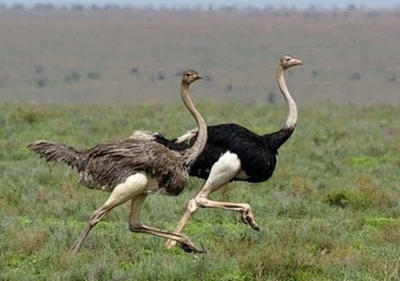
The ostrich is a large flightless bird, native to Africa. It is distinctive in its appearance, with a long neck and legs and the
ability to run at maximum speeds of about 70km/h (45mph), the top land speed of any bird. Ostriches formerly occupied
Africa, north and south of the Sahara, East Africa, Africa, south of the rain forest belt and much of Asia Minor. Today
Ostriches prefer open land and are native to the savannahs and Sahel of Africa, both north and south of the Equatorial
forest zone. In Southwest Africa, they inhabit the semi-desert or true desert.
Detail descriptions of game species


species top






more species
on page 2


= Descriptions




page 2



© Tusks and Tracks Africa : Design


Species Available to Hunt
in South Africa
African Wild Cat
Baboon
Black Wildebeest
Blesbuck
Blue Wildebeest
Bushbuck
Buffalo
Bushpig
Caracal
Civets
Common Duiker
Common Reedbuck
Crocodile
Eland
Elephant
Gemsbuck
Genet
Giraffe
Hippo
Hyena
Impala
Jackal
Klipspringer
Kudu
Lechwe
Leopard
Lion
Mountain Reedbuck
Nyala
Ostrich

Porcupine
Red Hartebeest
Rhino
Roan Antelope
Sable Antelope
Serval Cat
Springbuck
Steenbuck
Tsessebe
Vaal Reedbuck
Waterbuck
Warthog
Zebra





Make your selection and then Contact Us for
a quotation

